The case of Cassandra Lee Boskofsky exposes a disturbing pattern of negligence and systemic failures within the Anchorage Police Department (APD), highlighting the broader crisis of Missing and Murdered Indigenous Women in Alaska. This is not just a story of a missing person, but a case study in how crucial evidence can be mishandled and a family’s pleas for justice can be ignored.
Initial Neglect of Crucial Evidence
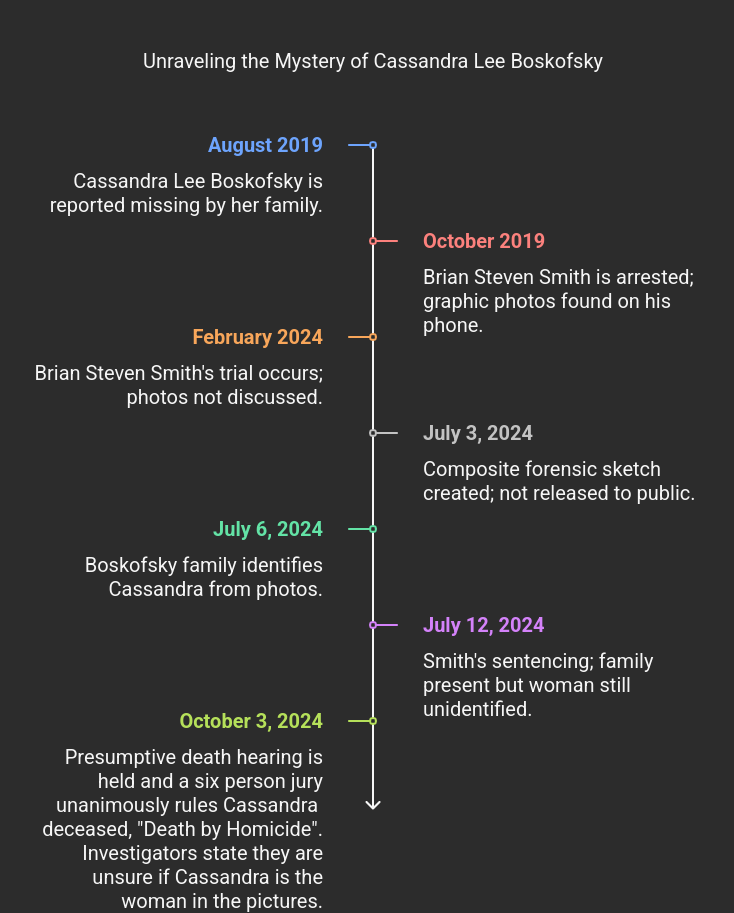
In October 2019, the APD made a critical error upon arresting Brian Steven Smith. On his phone, they found graphic photographs of a woman, severely beaten and likely deceased. Despite the clear signs of violence, these photos were not immediately connected to the missing person case of Cassandra Lee Boskofsky. Instead of pursuing a possible link, APD investigators claimed they couldn’t determine if the woman in the photos was even dead. This initial failure to act on crucial evidence set the stage for years of unanswered questions and delayed justice.
Suppressed Identification and a Delayed Revelation
Even with the shocking images in their possession, APD failed to connect them with Cassandra’s disappearance. A composite forensic sketch was created from the photos for a Sentencing Memorandum dated July 3, 2024. This sketch, which could have been instrumental in identifying the victim, was not shared with the public. This suppression of information further hindered the investigation and prolonged the family’s agonizing wait for answers.
A Family’s Anguish and the APD’s Mishandling
The Boskofsky family’s journey to find answers was filled with further distress due to the APD’s mishandling of the case. Instead of using proper channels, Detective Lee shared the graphic photos with the Boskofsky family via Facebook Messenger on July 6, 2024, leading to their immediate identification of Cassandra. This informal method of communication is a stark indication of a flawed investigative process. Adding insult to injury, during Smith’s sentencing on July 12, 2024, Judge Saxby was incorrectly informed that the victim in the photos in the sentencing memorandum had not been identified. The family, present in the courtroom, was forced to witness this cruel display of injustice.
Systemic Issues and a Call for Reform
The case of Cassandra Lee Boskofsky underscores a grave systemic issue: the neglect of marginalized communities and the failures of law enforcement to protect them. This case highlights the broader crisis of Missing and Murdered Indigenous Women in Alaska. The APD’s handling of the Boskofsky case, marked by inaction, poor communication, and a disregard for the family’s pain, exposes a system desperately in need of reform. The failure to act on crucial evidence and the repeated dismissal of Cassandra’s case reveal a system that is deeply flawed.
Unresolved Questions and a Community’s Plea
As of now, Cassandra’s remains have not been located. The APD has not publicly released the forensic sketch, although Alaska news outlet KNBA has. A reward is offered for information that could lead to the discovery of Cassandra’s remains.

The mishandling of evidence, the failure to communicate with the family, and the continuous claims of uncertainty, despite strong evidence, are all indicative of a system in need of serious reform. The community demands answers, accountability, and justice for Cassandra and her family.
As an Alaska Native woman, Cassandra’s case became another example of the systemic neglect faced by Indigenous women, who are disproportionately affected by violence and often overlooked by law enforcement. Smith himself states he deliberately targeted marginalized individuals, including sex workers, demonstrating a pattern of exploitation and violence directed at those deemed less worthy of protection. Cassandra’s story shows the broader issue of who the police choose to prioritize, often leaving those who are already marginalized, including “migrant workers, the houseless, the criminal justice impacted, and sex workers,” unheard and unprotected.
Cassandra’s family deserves answers, justice, and a full investigation into her disappearance and presumed murder.
 This Is How We Rise
Leave a comment