Anchorage police were warned about a man preying on some of the city’s most marginalized. They were told he was a killer. They didn’t investigate. And women died.
Police Were Told of Murder and Didn’t Investigate
Two women, neither wealthy, powerful, nor protected by status, risked everything to report Brian Steven Smith. One of them did so a full year before he tortured and murdered Kathleen Jo Henry.
On August 14, 2018, Alicia Youngblood called Anchorage Crime Stoppers. Alicia had moved to Anchorage from the Lower 48 and was a single mom, working alongside Smith at DOWL Engineering. What began as a relationship built on casual acquaintance turned into something far darker.
Smith boasted to shock her. Alicia assumed he was joking, until he wasn’t. One day he showed her a video of a woman he claimed he had shot and sexually assaulted. He laughed. She recognized his living room. She recognized his voice. She was horrified.
Alicia called Anchorage Crime Stoppers. She turned over texts showing Smith referencing things they had talked about.
For over a month, she stayed in near-daily contact with APD. Yet, rather than investigating, Officer Cordie dismissed her concerns as “sexual fantasy.”
She led them to the Eklutna Power Plant where Smith had bragged he “dumped a body.” A search dog alerted on a black bag. Police collected it as evidence. Later, it was thrown away by mistake.
Alicia spent the next month trying to get Smith to send her the video and images he had shown her. She showed texts to APD where she discussed the videos with Smith, trying to get him to say more about what he had shown her.
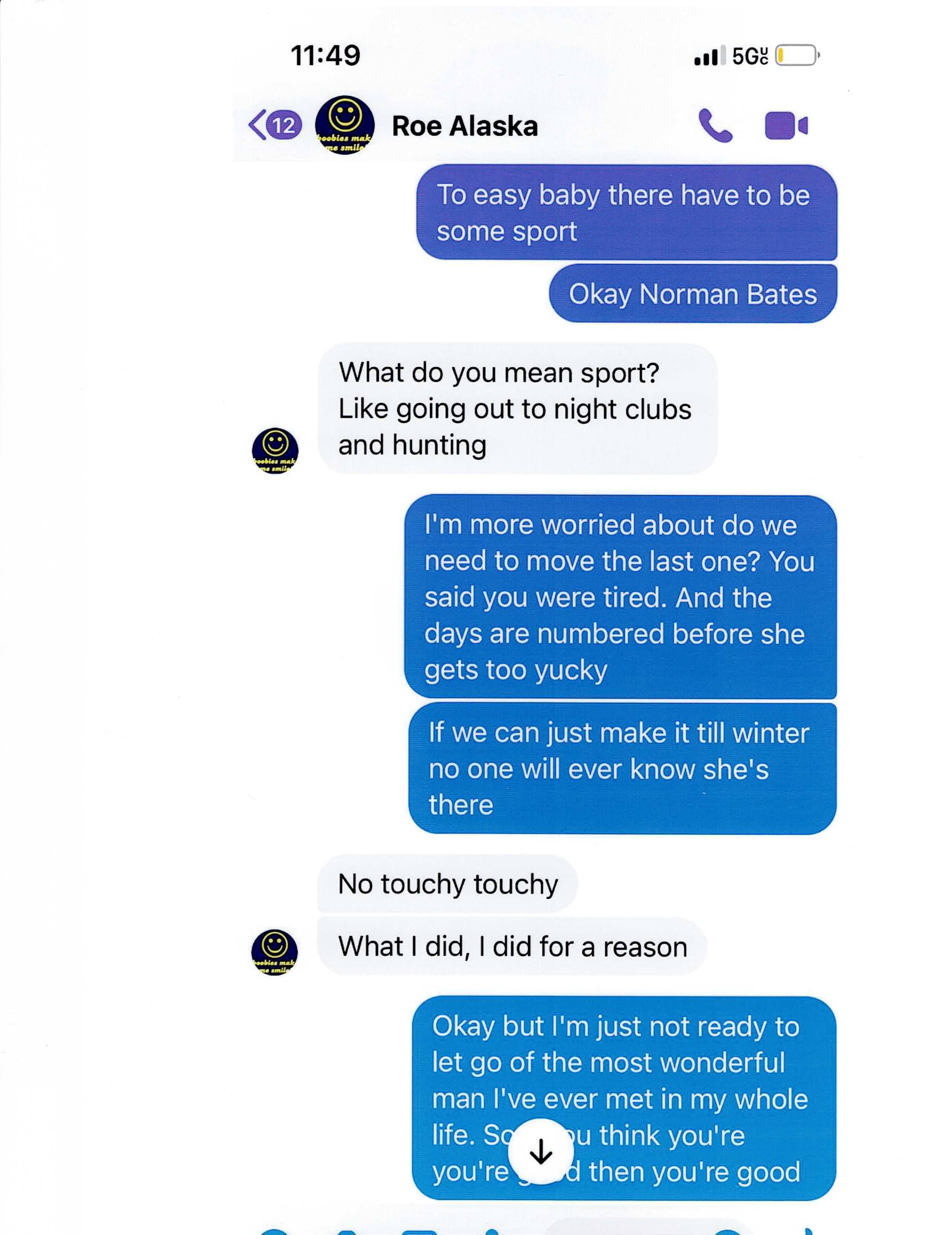
Reading the messages below between Alicia and Smith, keep in mind she was in daily contact with police, as you can see from the APD reports above.
Below are screenshots of Alicia texting Smith, trying to get him to send her the video and talk about what he had shown her.
She was in no way complicit or condoned his actions, rather she contacted the police and tried to get them to listen to her.


APD did not listen to Alicia’s claims that Smith was a killer. They never once went to question him.
By the end of September 2018 Alicia moved back down south near her family, she wanted out of Alaska.

Alicia had hoped APD would question Smith, and moved herself and her children away so she could feel safe.
She didn’t feel safe in Anchorage, and shared this on her Facebook page.
Maybe she was meaning the earthquake rather than a killer walking the streets?
Either way, she had hoped that the police were doing something with everything she had told them and showed them on her phone.
Despite corroborating details and evidence in hand, APD closed her case without ever questioning Smith.
They didn’t. Other women went missing. And on September 4, 2019, Smith murdered Kathleen Jo Henry in Anchorage.
A Phone, a Risk, and Another Chance to Stop a Killer
Fast forward one year later, Smith picked up Valerie Casler. He drove around Anchorage, attempted an ATM withdrawal, and dropped her off. She left with his burner phone, stolen when he was trying to get money out of the ATM. She was planning to sell it to survive. When she finally charged it, what she saw terrified her: images and videos of a woman being tortured. The same voice on the video as the man she stole the phone from.
Valerie warned other women to stay away from the man in the black truck. But she was afraid to go to police. Afraid of being arrested for theft. Afraid of being arrested for prostitution. Afraid, because the system taught her she should be.
Immunity Laws That Went Unannounced
There was a protection in place that could have saved lives, a protection Valerie never knew existed.
In 2016, after years of organizing by sex workers through Community United for Safety and Protection (CUSP), the Alaska Legislature added immunity to a Senate Bill – SB91. This bill gave sex workers the ability to report violent crimes like rape or murder without being prosecuted for prostitution. In 2017, Anchorage passed a matching municipal safeguard.
In both the State and Municipal assembly, this safeguard was fought against by APD and law makers, saying “prostitutes would just use the law to get out of charges.”
These laws exist so the very people most targeted by predators can seek help without fear of arrest.
But the victory went unpublicized.
Police didn’t train on it. Local media barely mentioned it.
A policy meant to end silence was introduced in silence.
A 2016 state law allows sex workers to report heinous crimes without prosecution. The author urges extending this to their clients.
Had Valerie known, she might have delivered that phone directly to an investigator. More evidence, possibly identifying more victims, might have surfaced sooner.
Instead, Valerie transferred the files to an SD card, labeled it clearly, and told police she found it near 13th Avenue and Fairbanks Street. When officers saw the label “Homicide at Midtown Marriott” they finally paid attention.
The SD card launched the investigation that would eventually expose a killer.
During questioning, Smith confessed to a second woman: Veronica Abouchuk.
Deleted footage recovered from his devices matched what Alicia had described more than a year earlier.
She Tried to Stop Him. No One Listened.
Alicia followed the news closely after Smith’s arrest. She knew what could have been prevented. Her family says the guilt and anguish never left her. On July 4, 2021, at just 41, Alicia died by suicide.
She became another casualty of a system that refused to take her seriously.
They Could Have Stopped Me
Three years to the day from Alicia’s funeral I sat down to interview Smith. Smith admits that had the police questioned him, their intervention would have stopped him from committing further crimes.
On July 9, 2024, I sat across from Smith in prison as he explained how easily police could have intervened:
“They had probable cause to speak to me… If the police had contacted me and I was guilty, that would have stopped me doing anything. Any deaths after that could have been prevented.”
Smith said it plainly: questioning him alone could have halted his killing.
Preventable Loss
The Smith case is not a mystery solved.
It’s a failure exposed.
Police did not believe Alicia.
They did not protect Valerie.
They did not investigate a man who bragged about murder.
Left unchecked, he hunted. He tortured. He murdered.
In this recording on July 9, 2024, Smith states if he “was an international killer and had been questioned, if they had… I would immediately say the police are watching me! I have gotten away with it, because they don’t have a body… then that would have stopped me from doing anything“.
AB: If the police had questioned you, what did you tell me about that?
Smith: Okay, so, so, if I actually was this international killer, um,
AB: International killer?
Smith: Yeah. Because remember, I told her that I killed people all over the world. It wasn’t just the South Africa people. I told her I traveled around. Everytime I told her something it was always exotic, the more exotic it was. So they had a lot of reason, probable cause, to speak to me, to come and speak to me, but they didn’t.
Smith: If they had, if I was actually the fellow, and they had come to speak to me, I would immediately say, oh, the police are watching me, I’ve gotten away with this because they didn’t find the body, so I’m not going to do anything wrong ever again while I’m here, I’m going to wait until I move to another town, you know?
Smith: So, if the police had contacted me and I am guilty that contact would have stopped me doing anything and therefore any this that happens after that 23rd or even after the crime stopper thing already because I mean she initially right in the beginning she gave them all the recordings so any deaths after that could have been prevented.
Smith: If I am guilty then those deaths could have been well would have been prevented because I would not have done, it’s called preventative crime.
The Smith case is just one example of the consequences of not investigating.
By failing to even question Smith, law enforcement allowed Smith to continue to be a predator to our community.
There is more to the Smith trial and conviction than meets the eye.
The story isn’t over
Brian Steven Smith is behind bars.
Headlines have moved on.
But justice has not.
This case reveals a deeper truth: when violence targets people society labels disposable, justice becomes optional.
That indifference cost Kathleen her life.
It cost Alicia her peace.
It has kept other victims nameless.
Smith isn’t even a serial killer by traditional reasoning, he has been charged and convicted for two deaths, although there are more he could be charged with. There are more APD could investigate, more families that could have some sense of closure and justive.
More to the Smith trial and conviction than meets the eye
Ian Calhoun.
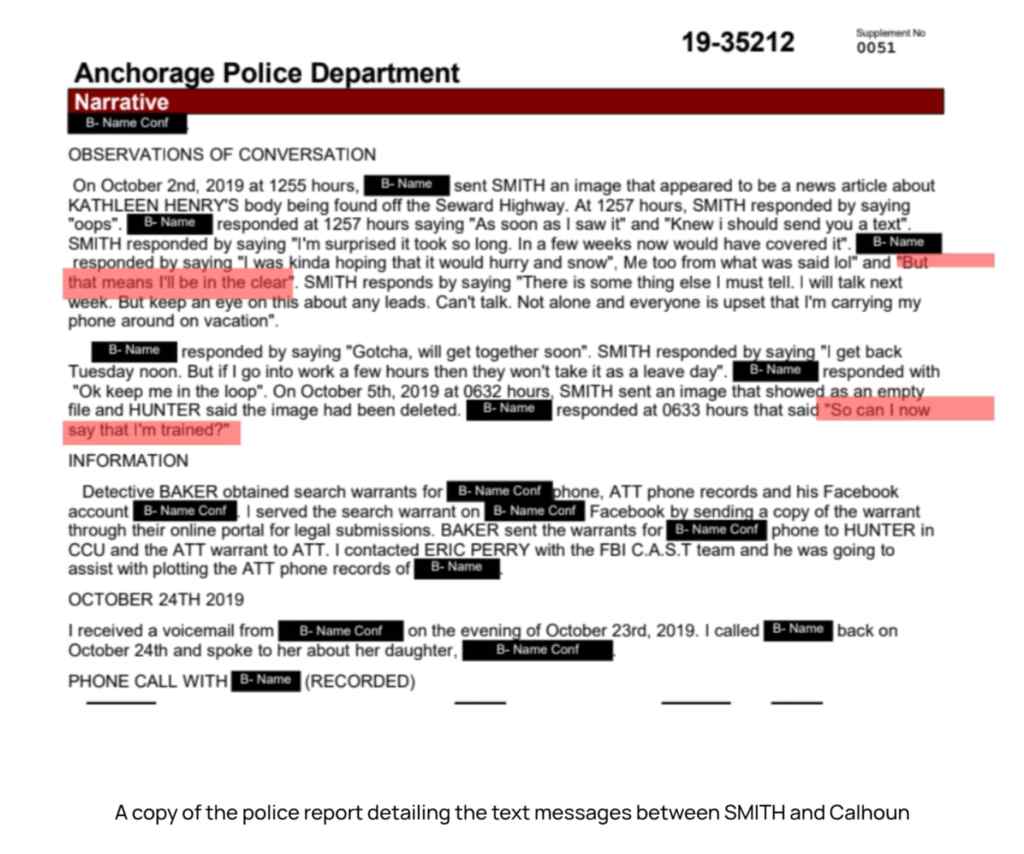
Ian Calhoun is a man Smith was texting during the torture and murder of Kathleen Jo Henry. Detectives later testified in state court that they believe Smith showed Calhoun a body and that Calhoun knew where Kathleen’s body was dumped.
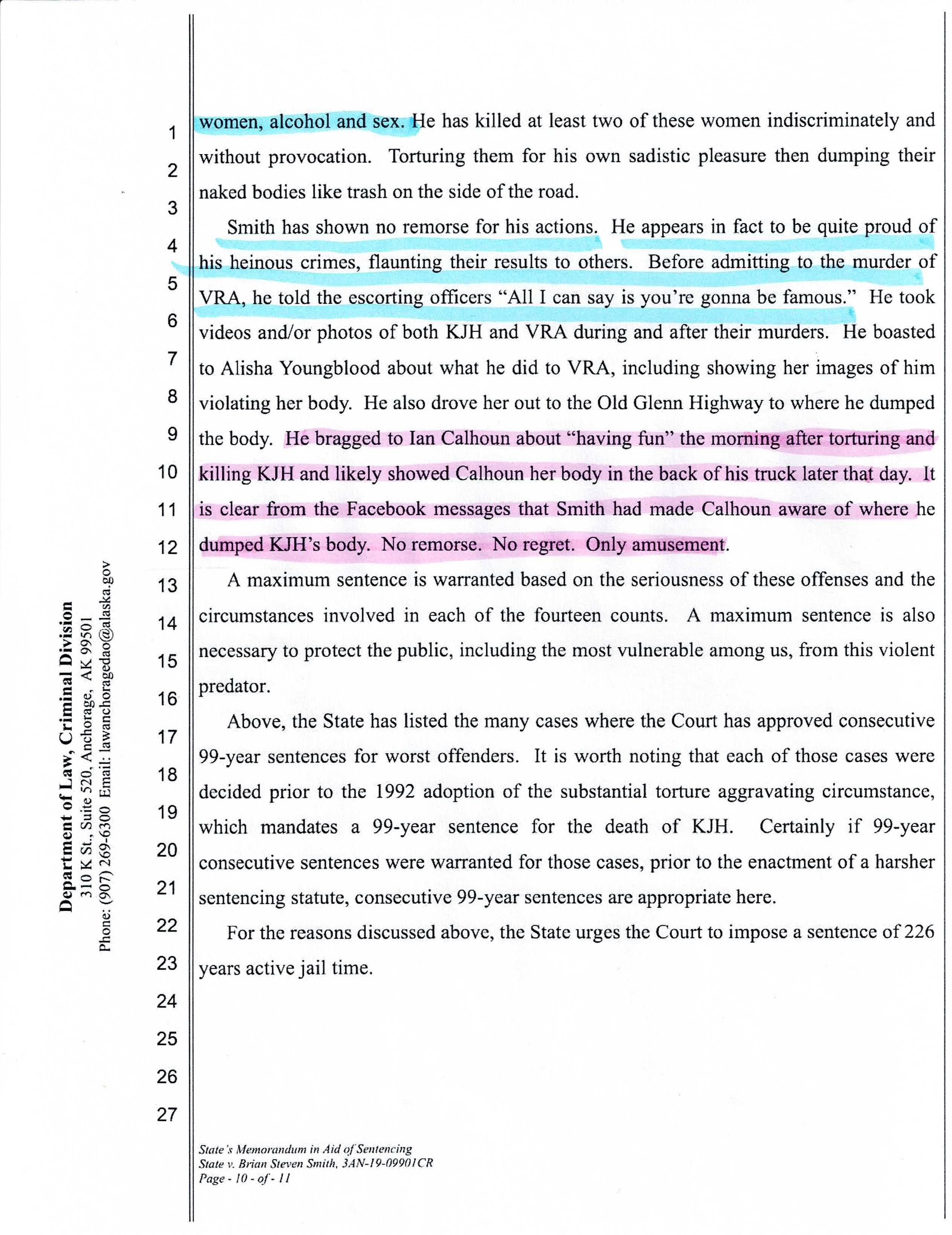
Early media coverage was incomplete. Anchorage Daily News did not report the final, chilling text Calhoun sent to Smith: “So can I now say that I’m trained?”
Unless we confront how police respond to violence against Alaska’s marginalized communities, Smith won’t be the last predator we help protect.
Kathleen Jo Henry deserved a future.
Veronica Abouchuk deserved protection.
Alicia Youngblood deserved to be believed.
Their stories reveal a truth Anchorage, Alaska, really Alaska as a whole must finally face: predators keep killing because our systems keep deciding certain lives are expendable.
Changing that truth requires more than arrests.
It requires listening.
Believing.
And treating every person’s safety as non-negotiable.
Anything less ensures the next warning will be ignored… and the next woman will die.
 This Is How We Rise
Leave a reply to Anonymous Cancel reply